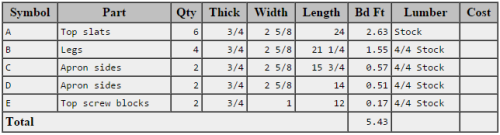
A board foot calculator, bill of materials generator and lumber tabulator all in one.
The tabulator can help you tally up your lumber requirements for your next project and create a professional-looking lumber materials list. It computes board feet by species, total board feet, cost by species, and total cost – with provision for an optional waste factor. It can also accomodate resawing, a feature not generally found in your run of the mill board foot calculators.
Tip: After clicking the Format for printing button, you can use your browser’s back button, enter additional project data, and then reclick the Format button to display the complete materials list.
Notes:
1. Hardwood lumber is typically sold by the board foot, a unit of volume equivalent to a board that is one inch thick, one foot wide and one foot long, or 144 cubic inches. Lumber thickness is expressed in quarters of an inch, beginning with 1 inch, so that 1 inch lumber is designated as 4/4, 1-1/2 inch lumber is 6/4, 2 inch lumber is 8/4, and so on. These units refer to nominal or roughsawn dimensions, not surfaced dimensions. The Tabulator rounds lumber thickness up to the next 1/4″ and lumber less than 4/4 is rounded up to 4/4. Thus, a finished thickness of 3/4″ will be treated as 4/4″ material. The program automatically computes rough thickness unless Rough thickness is specified under Optional Inputs.
2. Resawing involves ripping a board into thinner boards. For example, suppose you wish to resaw a 5/4″ board to create two 7/16″ thick pieces. The inputs to the Tabulator would be: Finished thickness: 7/16, No. resawn slices: 2, Rough thickness: 5/4, Kerf width (optional). If Rough thickness is not specified, it will be computed using the values for finished thickness and kerf width. If Kerf width is not specified, a default value of 1/8″ will be used.
3. A waste factor of 15 to 20 percent is typically used when determining lumber requirements to account for wood that is lost due to knots, splits, warpage, and other defects. Naturally, the poorer the grade of lumber that is used, the larger the waste factor should be. The Tabulator can accomodate different waste factors for the various wood types used in a project.
4. You can enter fractional wood dimensions as decimals (12.75), or as conventional fractions (12 3/4). If you use fractions, just make sure you leave a space between any leading whole number and the fraction.